
Friday, June 14, 2013

Wednesday, May 29, 2013
Replay Value
/Update%2005/2-ffvi05_002.png) |
| Edgar in a cave. (Final Fantasy III) |
In most Super Nintendo RPGs (role-playing games), you infiltrated an enemy castle or investigated a cave that appeared to be devoid of
life. Every few steps, however, the game triggered a random battle and you
found yourself fighting monsters who had been invisible (or nonexistent, depending
on how you looked at it) a second earlier. Unless you acquired a special item,
like Final Fantasy III’s Moogle
Charm, that nullified random battles, there was no way to avoid whatever
obstacles the game threw at you. Chrono
Trigger, released by Square Soft in 1995, was different. You could see, and
often avoid, the monsters onscreen before going into battle against them. When
you explored the mysterious Ocean Palace, for example, you could see its
denizens, and prepare for their attacks, before the fight began.
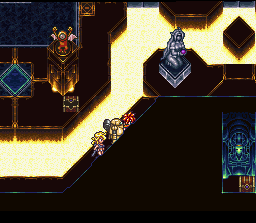 |
| Crono and co. sidestep an enemy encounter. |
Another of Chrono Trigger’s RPG innovations was its
replay value. Most RPGs told a linear story—you started as a young,
inexperienced warrior, gained power and weapons throughout the course of the
game, and defeated the final boss at the end—that remained largely the same
each time you played through the game. But after destroying Lavos, Chrono Trigger’s final boss, for the
first time, the game allowed you to roll over your levels and equipment and
start over, beginning the game as a buffed-up übermensch. This allowed you to complete the game in a fraction of
the time, but there was more. Chrono
Trigger’s plot involved traveling from one time period to another, fixing
problems in the past and then visiting their repercussions in the future. One
of the time periods was the “Day of Lavos,” where you confronted the parasitic
alien and beat the game. When you started the game over (the option was called
“New Game +”), you could access this time period from the very beginning of the
game onward, and depending on where you were in the storyline, you would unlock
a different ending when you defeated Lavos. For example, if you went to the Day
of Lavos right before you defeated the nefarious Reptites in the prehistoric
time period, the ending showed your characters transformed into Reptites
themselves, because your non-intervention in the distant past altered the
development of life on Earth.
 |
| Reptite Crono's mom tries to wake him up. |
I defeated
Lavos more time than I can count, trying as many different strategies and ideas
as I could think of to unlock all of the game’s endings and maximize its replay
value. I wanted to master the game, uncover all of its secrets, learn how to
beat it from the inside out. I was an obsessive kid, so I also did the same
thing with games like EarthBound, Final
Fantasy III, and Secret of Mana,
which have little replay value compared to Chrono
Trigger. Those games remained the same each time I played them, allowing me
to memorize lines of dialogue and the attack patterns of enemies; the games
could not surprise me, and rather than swallowing me in a mire of boredom,
playing a game I had already mastered was a source of comfort. I knew exactly
what it could do to me, and I also knew I was strong enough to overcome it.
I continued playing and re-playing games all throughout high school and college. In grad school, though, I became too busy to do anything beyond reading, writing, and grading. I told myself this was evidence of my growth and maturation into an adult. As soon as I finished my last project, however, the itch to play a game surfaced again. I wasn’t interested in finding a new challenge, though. I wanted to re-play Secret of Mana. At the time, I thought it was a mere bout of nostalgia for one of the greatest games ever created.

Now, I know
it was more than that. I didn’t know what I wanted to do with my degree, or
where I was going to work, or live, or even who my friends would be. I was
transitioning from having nearly every element of my life scripted in syllabi
to knowing practically nothing about my future; I wanted something I knew I
could handle, and Secret of Mana
provided an unthreatening challenge.
Secret of Mana is a fairly long game, and beating it usually took me a week or two. In my post-grad school frenzy, though, I blitzed through it in three days. As I watched the ending sequence play out on the screen, I was sad, knowing I would have to tackle a new test now. But I had not played Chrono Trigger in years. What if I had somehow missed an ending? The internet and its libraries of walkthroughs and strategy guides wasn’t around to help me back then, after all.
I started making a list of games, both those I had played before and ones I had missed, to track down and use as a distraction. The list has grown quite long. It might be years before I exhaust it, and by then, I'm sure I’ll be itching to fire up Secret of Mana once again.
Saturday, May 25, 2013
Finding Jesus in Star Trek Into Darkness
***Spoiler Warning if you don't already know who's who and what's what in Star Trek Into Darkness***
I've been hearing speculation that Captain Kirk is meant to be a Christ figure in Star Trek Into Darkness (STID). The theories have some merit, since Kirk sacrifices himself to save his crew/followers and is then raised from the dead a little bit later, but they also ignore the STID character with even more direct Christological characteristics: Benedict Cumberbatch's John Harrison/Khan.

Consider, first of all, Khan's motivation for his admittedly outlandish plot: He wants to his followers, whom he has secreted away in the special-edition photon torpedoes on the Enterprise. Right there, we have one of the same markers cited in defense of Kirk's alleged Christology. But the evidence with Khan goes further. Do you recall how many followers Khan had? 72. And where else have you seen that number?
Luke 10:1
"After this the Lord appointed seventy-two others and sent them two by two ahead of him to every town and place where he was about to go."
That's right. Jesus sent out 72 followers, and Khan had 72 followers cryo-sleep-stored in the torpedoes. Coincidence?

It goes beyond that, though. This next piece of evidence is even more compelling. In fact, I can’t imagine anything that could be more convincing.
At three different points in the movie—with the sick child near the beginning, a Tribble near the middle, and with the dead Kirk close to the end—Khan’s blood is used to bring dead things back to life. Strangely, STID chooses not to dwell on this point, but the evidence is nonetheless clear: Khan’s blood can cure death, thus granting whoever has it eternal life.

Does that sound like anyone else you know?
John 6:56
“Whoever…drinks my blood has eternal life…”
Now, I will admit that Khan does a few un-Jesus-like things,
such as killing lots of people, lying, manipulating, being the villain of the
story, and crushing skulls with his bare hands, but those are minor quibbles--Tribbles? :)--compared to the mountains of evidence showing Khan as Jesus. So, the next time
you have trouble picturing what Jesus might have looked like, just think of
Khan instead.

Wednesday, May 15, 2013

Tuesday, April 16, 2013
@PrayForBoston: The Marathon Bombing and Sandy Hook
Note: I created this as a PowerPoint presentation to show to my classes. We're discussing how to evaluate arguments and evidence.
@PrayForBoston
•In the hours after the Boston Marathon
bombing, the hashtag #prayforboston
was trending on Twitter. People used it to express their support and sympathy
toward the victims of the bombing.
•Also on Monday, a Twitter account with
the name @PrayForBoston
posted two photos that quickly started trending, as well.
 |
R.I.P. to the 8 year-old boy who died in
Boston's explosions, while running for the Sandy Hook kids. #prayforboston
|
 | ||||
R.I.P. to the 8 year-old girl who died in
Boston's explosion, while running for the Sandy Hook kids. #prayforboston
•Each of the two photos were retweeted
tens of thousands of times.
•When I saw them, though, something seemed
off.
Finding Facts
•The Boston Marathon honored victims of
the Sandy Hook school shooting by dedicating each mile of the race to someone
who was killed (there were 26 Sandy Hook deaths; a marathon is 26.2 miles).
•A group of runners from Newtown, CT
(where Sandy Hook is located) participated in the Boston Marathon as a way of
honoring the victims.
•Reports confirmed that an 8-year-old died
as a result of the bombing. Identity was not immediately disclosed.
•The girl’s picture shows her wearing a
bib for the “Joe Kinsella 5K."
•Captions for both pictures assert that
the boy and girl were running in the Boston Marathon.
•Runners must post a qualifying time in a
previous marathon in order to qualify for Boston. (Most marathons are open to
the public.)
•The youngest qualifying age group is
18-34 years old. (Marathonguide.com)
•The Newtown runners announced on Facebook
that no one in their group had been injured, because “all runners completed the race before
the explosions.”
•A day later, Twitter had suspended the @PrayForBoston
account, as well as other similar accounts.
•Reports circulated that the 8-year-old
victim was named Martin Richard, and he was waiting for his father at the
finish line.
•The last detail was false: Martin’s
father did not run the race, but the family was gathered to watch at the finish
line.
•His mother and sister were also seriously
injured.

Rush to Retweet
•Imagine if you knew one of the kids in
those two pictures. How would you have reacted?
•What do you think motivated someone to
create and share those pictures?
•Why did they spread so quickly on the
internet?
|
Tuesday, April 2, 2013


Saturday, March 9, 2013
Daylight Saving Sequester

The United States Department of Watches and Clocks (DWC) has announced that the 2% across-the-board cuts mandated by the sequester will also apply to Daylight Saving Time.
Thus, instead of the standard one hour "Spring Forward" tonight, US residents should only set their clocks ahead 58 minutes and 48 seconds.
At this morning's press conference, DWC spokesman Lazar Willard explained, "Most computers and cellphones update the time change automatically, and manufacturers did not anticipate anything like the sequester actually coming to pass. This means that all US residents will need to manually adjust the time on their digital devices."
When asked what would happen to the missing 72 seconds, Willard answered, "The missing time cannot go toward something like paying down leap year, obviously. That would just be silly. A committee led by DWC official Harry Bemis has been convened to evaluate our chronoptions."
Subscribe to:
Posts (Atom)