I'm a graduate student a Ball State University, studying creative writing. Don't judge. I'm not good enough at anything else to try and make a career out of it.
I finished re-reading Cloud Atlas this afternoon. This
time, instead of reading the book
straight through, I read both parts of each
story before moving on to the next one. Cloud
Atlas is divided into six separate stories, and each story is divided into
two halves. The structure of the book looks like this:
You end up moving forward in time, from Adam to Sloosha’s,
and then back in time from Sloosha’s to Adam again. Thus, while Sloosha’s is
the chronological end of Cloud Atlas,
it occupies the center point or fulcrum of the book itself.
The fancy word for a structure like this is a chiasm. It’s
an unusual way to tell a story, but Mitchell gets a lot of mileage out of it by
having a character in one story discover the previous/next story in the
sequence. For example, Robert Frobisher, the protagonist in “Letters from
Zedelghem,” finds the first half of “The Journals of Adam Ewing” (i.e. the part
of the book you have just read) in the house where he’s staying; and in “Half-Lives:
The First Luisa Rey Mystery,” Luisa finds a pack of Frobisher’s letters in her
story.
As intriguing as the nested-stories conceit is, it does have
a serious downside: If you read the book straight through, as I did on my first
read, there will be a lot of time between finishing the first half of “The
Journals of Adam Ewing” or “Letters from Zedelghem” and starting the second
half. I basically didn’t remember who Adam Ewing is or what his deal was when I
got to the end of the Cloud Atlas.
When I read through the novel chronologically (all of “Adam,”
then all of “Zedelghem,” then all of “Luisa,” etc.), I appreciated each story
as an individual story more, because I still had the beginning in my head when
I got to the end. At the same time, though, I think I lost some appreciation (or
at least awareness) of how the stories overlap and interconnect.
I do think, though, that the reincarnation/repetition theme
is one of the weaker parts of Cloud Atlas.
And judging by the trailers, that seems to have become one of the dominant
themes in the movie.
Reading Lauren Oliver’s novels Delirium and Pandemonium made
me self-conscious. Last Saturday, I went to a concert at Cerulean, a local
restaurant, featuring the excellent band The Vespers, and I brought a book
along with to read during the lulls. This is standard operating procedure for
my life—I’ve brought books to read when I waited for doctor’s appointments, job
interviews, and while eating at fast food restaurants. I also read when I’m
watching sports on TV. The ones with a lot of downtime work best—like football
and baseball—but I have also figured out how to sneak in a sentence or two when
the point guard dribbles the basketball court.
Normally, I don’t give a second thought to who might see me
reading in public, or to which book I take with me. I brought Pandemonium with me to the Vespers
concert, and I was very aware of how it might look for me—a 27-year-old single
guy—to be reading a novel whose target audience is teen girls. And as you can
tell from the cover, Pandemonium is clearly a "girl" book.
Oliver’s trilogy—the third book, Reqiuem, will be published next year—is set in a world where love
has been classified as a disease (Amor
Deliria Nervosa) and is “cured” by a government-mandated procedure. The
plot follows Lena, a normal girl who—you guessed it—meets a boy and “gets the
disease” the summer before she is due to be cured. That summary turned me off
initially, but I kept seeing Oliver’s name on “best YA sci-fi books” lists, so
I finally decided to give Delirium a
try.
(By the way, I’m writing a YA sci-fi novel, so reading
authors like Oliver, Julianna Baggott, Neal Shusterman, and Scott Westerfield
counts as research. And I just like reading them.)
The further I got into Oliver’s fictional world, I was
impressed by the detail and thought she put into all the ways a cure for love
would reshape the world. Religion, education, literature, and family all get
woven into the story. As for the love story, I could take it or leave it. And
aside from all the world-building, Oliver is just a good sentence-level writer.
The quality of her prose is quite a bit higher than most YA novels I read.
So…there were plenty of perfectly defensible reasons for me
to be reading Pandemonium, but as I
walked across the parking lot to the concert, I held it so that the back cover
was facing outward and the front cover hidden against my leg. I probably could
have found a chair to sit in, but that might have attracted attention, so I sat
in the grass to the far right of the stage. And just in case someone recognized
me, I kept the book flat in my lap, so he wouldn’t see what I was reading.
Of course, someone did. A friend parked his bike at the
nearby rack, waved, and came over to say “hi.” He mentioned how absorbed I
seemed to be in my book and that it must be good, and I nodded and agreed. I’m
usually eager to talk about whatever it is I’m reading, but on that evening I
didn’t mention the author or title, and I certainly did not lift my book up so
he could see the cover.
It’s like I was a character in Oliver’s world, scared an
undercover Regulator would see my inappropriate reading material and arrest me
on the spot. No one did, of course, because I don’t live in a totalitarian
police state, but I still think I would have gotten some weird looks if I had
been caught.
There are no laws against reading, but certain kinds of
books do carry a stigma with them, and as a *sci-fi* *Young Adult* *girl* book,
Pandemonium is a literary ghetto hat
trick. Even though it’s a good book, and I enjoyed reading it, and it gave me
helpful instruction on world-building and plot structure, I didn’t want you to
know I was reading it.
Because I’m me, I kept thinking of an obscure Belgian movie,
Ben X, while I was reading/listening
to Jay Asher’s novel Thirteen Reasons Why.
The novel begins with high schooler Clay Jensen receiving a package with no
return address. Inside it is a series of tapes that Hannah Baker recorded
shortly before committing suicide. The tapes promise to detail who and what led
her to that decision. The “reasons” of the title refer to the thirteen people
addressed on Hannah’s tapes, and her instructions are that once you have
finished listening, you have to send them on to the next “reason”; if you
don’t, a second copy of the tapes will be released publicly.
Thirteen Reasons Why follows
Clay around town as he listens and reacts to the tapes. The novel is formatted
with Pause and Play buttons in the text to show when the perspective switches
from Hannah’s recorded voice to Clay’s first-person narration; the audio book
uses separate voice actors for Hannah and Clay, which makes the transitions
even easier to follow.
The novel reveals Hannah’s death one the very first page,
but as I progressed through the story, I kept having doubts as to whether she
was really dead. First, she didn’t have a funeral and it wasn’t clear who or
how many people had seen her body. Second, Thirteen
Reasons Why is a young adult book, and even with violent series like The Hunger Games and the Maze Runner trilogy out there, having a
suicidal protagonist who actually goes through with her plan seemed too dark
for a YA publisher to want to touch. The third reason is the obscure Belgian
movie Ben X (available on Netflix streaming).
The protagonist of Ben
X has Asberger’s Syndrome, which makes it difficult for him to interact
with the world around him. The constant bullying he endures at school doesn’t
help, either. To help himself cope with the real world, Ben views it through
the lens of ArchLord, the online role-playing game he plays at home. He brings up an overworld map to
navigate from home to the bus to school; he sees his bullies as monstrous ogres
and imagines chopping of their heads.
(Note: Ben X is
not related in any way to the similarly-named cartoon series Ben 10. Ben X is the name Ben uses for
his ArchLord avatar; it also means “I am nothing” in Dutch gaming slang.)
The torment from Ben’s bullies and the inability or
unwillingness of his family and teachers to do anything to help him pushes Ben
to contemplate suicide. Before he can follow through with his plans, though, he
receives a message from Scarlite, his frequent partner on ArchLord missions, saying she is worried about him and wants to
meet in real life.
(The rest of this post is going to have several major
spoilers for both Thirteen Reasons Why
and Ben X.)
Instead of merely trying to talk him out of his plans,
real-world Scarlite tells Ben his “Endgame” is weak. He needs to find a way to
make everyone feel the pain that’s driving him to suicide. And this is where Ben X and Thirteen Reasons Why really converged for me, because Hannah’s goal
in recording and distributing her tapes is to see and confront what they did
(and didn’t do) to her.
Together with his family, Ben and Scarlite concoct a plan to
stage his suicide and record it on video. That video, along with footage of Ben
being humiliated at school and interviews with his parents and teachers, are
played at Ben’s funeral. Ben is hiding in the balcony, and when Scarlite
finally convinces him to stand up and reveals himself, the light from the
projector behind him appears to give him angel wings.
To use the language of video games, Ben’s life ended when he
died on the screen, and now he can restart with a new life.
I kept waiting for a similar twist in Thirteen Reasons Why. I thought the final instructions on the last
tape would lead Clay Jensen to the spot where Hannah has been hiding out while
the tapes pass from one of her “reasons” to the next, and she would get to
confront the people who have hurt and failed her.
But that doesn’t happen. Unlike Ben, Hannah does not get a
triumphant resurrection scene. She is really dead, and has been through the
whole novel. Thirteen Reasons Why
does not end on a completely dark note, however. In the final scene, Clay notices
a girl named Skye whom he knew in middle school but has ignored for years. With
Hannah’s voice still fresh in his memory, he decides to talk to Skye and see if
she’s okay, because even though it’s too late for him to save Hannah, he might
be just in time for Skye.
And while the ending of Ben
X is hopeful, the story behind it is tragic. Writer/director Nic Balthazar
adapted his novel Nothing Was All He Said
for the movie, and in an interview, he explained that he had been inspired by reading a newspaper story about an
autistic boy who committed suicide in Balthazar’s hometown of Ghent. In his
suicide note, the boy said he had been bullied to death.
Note: This post reveals spoiler-type points about the movies and books it discusses.
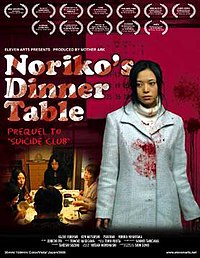
Noriko’s Dinner Table
has been on my Netflix radar for a while now, and I even started watching it
once before, but I gave up after I figured out it’s the sequel to a movie I
hadn’t yet seen (Suicide Club). I was
browsing through my Netflix Instant queue (I don't get DVDs from the right now)
the other day, saw that Noriko was
going to disappear at the end of June, and decided I wanted to give it another
try.
Luckily, Suicide Club
was available for a cheap online rental on Amazon, so I watched it last night
and Noriko this afternoon. One thing
that struck me is that, even though both movies look similar visually and fit
together nicely, they are very different in several ways. The first is in tone:
Suicide Club is a horror movie, quite
gory in a few scenes and genuinely disturbing in several more; Noriko mostly sidesteps the horror
tropes, and ends up feeling like more of a dysfunctional family drama.
Another major difference is how each movie tells its story: Suicide Club is much more image- and
event-driven, while Noriko relies
(too much, in some places) on voiceover narration. At times, it feels more like
an illustrated novel than a movie.
Along with that, there’s a marked difference in how
characters are used in each movie, and as a result, the scope that they try to
cover. Suicide Club’s opening scene
(and the sequence at the center of both movies) shows numerous Japanese high
school girls lining up along the tracks at a train station. As a train pulls
in, the girls (54 of them) jump onto the tracks and are killed, with
accompanying explosions of blood.
In contrast, Noriko begins in a similar location, but instead of a grisly tableau, we listen to the teenaged title character explain that she has run away to Tokyo.
As Suicide Club
continues, the original mass train suicide seems to set off an epidemic, with
several scenes of Japanese people (mostly young people) killing themselves,
sometimes with a group, other times individually. Each soon-to-be dead
character only gets a scene or two before they die, making it difficult, first,
to understand why they want to die, and second, to identify with the characters
on a personal level. Thus, the focus of these scenes focuses more on the
phenomenon of suicide than with the characters who are dying.
Noriko, on the
other hand, indulges in extended backstory sequences explaining where Noriko
and her family live, and how and why she decides to leave her hometown and run
away to Tokyo. She has connected with a group of girls on an online message
board, and all of these girls live in the big city; thus, Noriko believes she
will not be lonely if she can meet them in real life. If you pay attention,
you’ll recognize that the website Noriko frequents also plays an important role
in Suicide Club, but other than that,
the two movies don’t feel very closely connected early on.
(SPOILERS in the next paragraph)
Gradually, we come to learn that the Noriko’s message board
friends are also responsible for the mass suicide at the train station (and
other events before and after it), and we see how the characters we have come
to know are part of a larger movement. Suicide
Club does the opposite, focusing on the events of the movement without
revealing who is behind them until late in the film, and even then, it’s really
hard to figure out why they are committing these acts of destruction.
The only other example I can think of where the same creator
(Shion Sono wrote and directed Suicide
Club and Noriko’s Dinner Table)
used such different storytelling modes in the same overall work is Jose
Saramago’s novels Blindness and Seeing. In Blindness, we follow a small group of individuals struggling to
survive after an epidemic of blindness has left everyone (except for one
character) unable to see. Seeing picks
up the story after (SPOILER) humanity has regained its sight, and is working to
put society back together. Most of its scenes are set in boardrooms and offices
where high-powered archetypes discuss everything that has happened.
The Noriko/Blindness approach to a story is more
common these days (The Hunger Games
novels are another example, as are most YA novels), I think because it’s much
harder to get readers and viewers to invest in a story if they don’t care about
the people in it. Action movies tend to focus more on events than characters,
but even then, audiences are usually given an identifiable protagonist (like
Sam Witwicky in the Transformers
movies).
I’m not sure which mode I prefer. I tend to fall more on the
character side, but in the case of Suicide
Club and Noriko’s Dinner Table, I
think Suicide Club is a better movie.
Not having a central character gives each scene a palpable sense of danger,
because you’re never sure if a given character is going to survive his or her
next scene. And in a horror movie, that’s a major asset. At the same time,
though, the emotional payoff in Noriko
is more immediate, first because it’s much easier to understand what’s going
on, and second because we have invested a significant amount of time with the
central characters.
Personally, though, I found myself more in the grip of the
anything-could-happen existential crazypants of Suicide Club. It was more than the challenge of trying to piece
together a coherent narrative, too; the central character void allowed me to
enter the psychological space of the story in a way that I could not have if a
traditional protagonist were embodying those feelings and showing me how they
react to them.
NOTE: This post discusses, in general terms, aspects of The Man from Primrose Lane you should ideally not know before reading the novel.
A few years ago, I read Long for This World by Michael Byers. It’s about a doctor researching the
fictional Hickman Syndrome, which causes cells to deteriorate, making those
afflicted with the disorder age rapidly and die before they reach adulthood.
During his research, the doctor discovers a remarkable boy whose cells don’t
seem to deteriorate at all. This boy could be the key to curing Hickman, and
potentially to stopping death itself.
Byers get to the border of some really interesting territory
in the book—what if we could life forever?—but instead of exploring it, he
stops. The remarkable boy dies, and life (and death) goes on as it always has.
I had selfish reasons for wanting Long for this World to go in a more fantastic direction—I’m writing
a novel about a world where people don’t have to die—but I can understand why
Byers cut off his plot where he did. If he had not, it would have pushed his
novel onto the science fiction shelves, and since Byers teaches in the MFA
program at the University of Michigan, he probably doesn’t want his name to end
up there. (I don’t have time to go into it here, but genre writing and MFA
programs usually don’t mix.)
I was reminded of Long
for this World when I read The Man from Primrose Lane by James Renner (I first heard of Renner in the video below, where he explains the book publishing process using Star Wars figures).
Renner’s book is about a true crime author’s search for a serial killer, which
is, of course, a completely different plot than Long for this World.
The similarity is that Primrose Lane
also comes to a point where is could either follow a more traditional story arc
or take a turn toward “the genres” (Junot Diaz’s phrase), and where Long for this World stops, Primrose Lane leaps headfirst into
crazytown. I don’t mean that as a insult; I rather enjoy leaps into crazytown.
The strange thing is, though, I felt somewhat cheated when I
realized where Renner’s book was going. I thought I was reading a
straightforward crime procedural, and ended up getting a time-travel saga that
plays like a mashup of Primer and Timecrimes, both of which you should watch if you haven't already.
I imagine this is how a lot of people would have felt if Long for this World had followed its
eternal life rabbit hole all the way through to its natural conclusion.
The reason for my reaction, I think, had to do with how my
expectations had been groomed through the early sections of the book. You don’t
find out what’s “really going on” until halfway through the book, by which time
I had already decided what sort of book I thought I was reading. (Primrose Lane isn’t being marketed as a
science fiction novel, even though it really is; the jacket copy calls it
“genre-twisting,” but wisely doesn’t mention which genres it twists.)
I read enough books and watch enough movies that it’s hard
to surprise me, so I’m usually grateful when it happens. But when I got to the
big reveal in PrimroseLane, I was somehow disappointed to
discover I was reading one of “those” books.
I kept going, though, and while I ended up liking Primrose Lane, I’m a little mad at
myself for not liking it more than I did, since it really is the kind of book I
want to write.
I have never been very interested in historical fiction. For
a long time, I thought that was because my interests skewed more toward science
fiction, and I thought those two genres were on opposite ends of the spectrum.
Historical fiction, of course, deals with things that really happened, while
science fiction deals with things that haven’t happened (yet, at least).
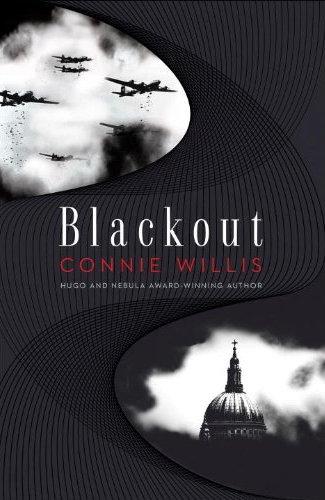
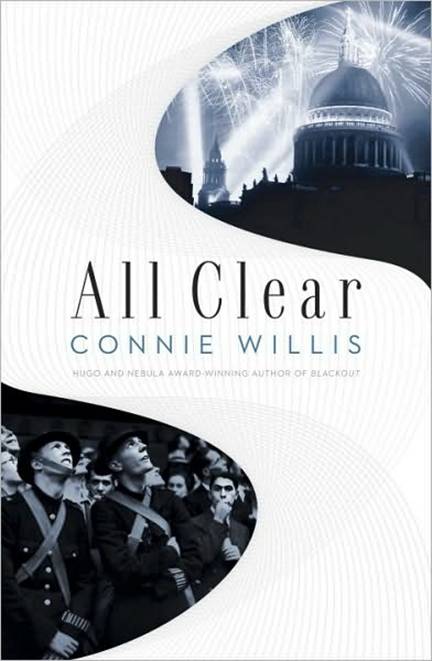
I recently finished reading Connie Willis’s novels Blackout and All Clear (both books tell a single story—it’s more accurate to call the work a two-volume novel, except no one writes those anymore). My experience with Willis’s books is making me rethink the historical fiction-science fiction binary.
The setup of Blackout and
All Clear is that historians at
Oxford University in the year 2060 can use time travel to go back and see what
life was really like back then. The plot follows three historians who are all
studying different aspects of WWII England, especially Germany’s bombing of
London. One of the jacket blurbs jokes that the level of period detail will
make you think Willis had access to the time machines in the books, and I’m
inclined to agree.
I recently graduated from Ball State University with a
Master’s in Creative Writing, and one of my professors, Cathy Day, talked about
the time and effort it takes to research historical fiction; she wrote about a
the origins of her hometown’s circus in The
Circus in Winter and is currently working on a novel about Cole Porter’s
wife.
Thinking about the amount of work Connie Willis must have done to get all
the details just right in Blackout and
All Clear boggles my mind.
The way that Willis evokes distinct time periods in the
novels—1940s London and a futuristic Oxford—as well as combines these two
genres, has made me realize that historical fiction and science fiction both do
the work of world-building. That is, they attempt to flesh out and represent a
world significantly different from the world in which the author lives.
The difference comes from how the author constructs those
worlds. An author writing historical fiction is bound by how the world really
was—the kinds of materials they used for clothes, when a given song was
recorded, the dialect and jargon of the period—whereas an author writing
science fiction is bound by the particulars of the world they envision—whether
time travel is possible, if aliens have visited Earth, what kinds of technology
have been invented. Both end up limiting the choices an author can make about
the world they create, although the rules for each genre are different.
I’m currently working on a science fiction novel about a
world in which a machine allows people to come back from the dead, and noticing
the kinds of choices Day and Willis had to make when they wrote their
historical stories is helping me to think through all of the little details
that will build and define my fictional world.