James Renner, author of the novel The Man from Primrose Lane, which I haven't read but want to, explains the publishing world in the most logical, straightforward manner possible--with Star Wars figures.
Friday, May 4, 2012

Saturday, April 28, 2012
Caitlin Horrocks and Omniscient Perspective
Now that I'm almost finished with my Master's degree, I finally have time to read book that I'm not required to read. The one I'm working through right now is This Is Not Your City by Caitlin Horrocks.

I first heard about Horrocks when she visited Ball State University (where I'm getting aforementioned degree), and she's an interesting author as well as an engaging speaker. During the visit, she talked about how some of her stories are the result of challenges or exercises she sets for herself. For example, the first story in the collection, "Zolaria," came from Horrocks deciding to write a story that went forward as well as backward in time.
That idea of stories as challenges stuck with me, and now as I'm reading This Is Not Your City, I'm trying to reverse engineer the finished stories back to the original challenge. I haven't figured out all of them in this way (and I don't think all of them had that kind of inspiration), but the story I read this afternoon seems to have a challenge behind it.
The story is "At The Zoo," which, as the title implies, is about a grandfather, mother, and son spending the day at a zoo. It's not an especially complicated story on the surface, but as I got further in to it, I noticed it was doing something unusual.
Most stories and novels (and even most other stories in Horrock's collection) these days are either written in first-person (an "I" narrator tells the story) or third-person limited omniscient (using "he, she, they," and only hearing the interior thoughts of one character in the story). People seem to think that getting in the head of more than one character is cheating or playing God or something, and it's generally discouraged.

I first heard about Horrocks when she visited Ball State University (where I'm getting aforementioned degree), and she's an interesting author as well as an engaging speaker. During the visit, she talked about how some of her stories are the result of challenges or exercises she sets for herself. For example, the first story in the collection, "Zolaria," came from Horrocks deciding to write a story that went forward as well as backward in time.
That idea of stories as challenges stuck with me, and now as I'm reading This Is Not Your City, I'm trying to reverse engineer the finished stories back to the original challenge. I haven't figured out all of them in this way (and I don't think all of them had that kind of inspiration), but the story I read this afternoon seems to have a challenge behind it.
The story is "At The Zoo," which, as the title implies, is about a grandfather, mother, and son spending the day at a zoo. It's not an especially complicated story on the surface, but as I got further in to it, I noticed it was doing something unusual.
Most stories and novels (and even most other stories in Horrock's collection) these days are either written in first-person (an "I" narrator tells the story) or third-person limited omniscient (using "he, she, they," and only hearing the interior thoughts of one character in the story). People seem to think that getting in the head of more than one character is cheating or playing God or something, and it's generally discouraged.
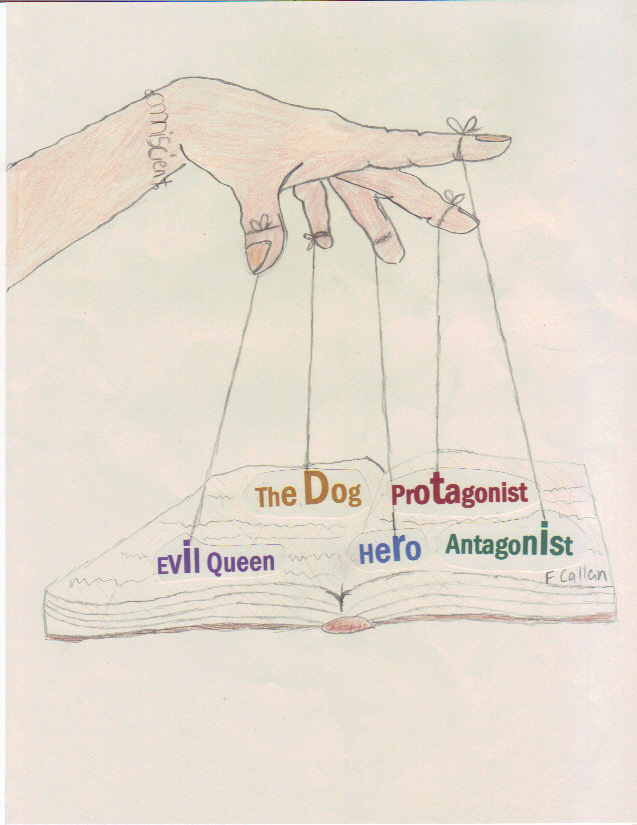 |
| Picture from here. The bracelet around the wrist spells out "omniscient." |
In "At The Zoo," however, Horrocks moves in and out of the heads of each of the three main characters. At one point, the mother, an attorney, thinks about the mad scientist who wants to patent his time travel machine; at another, the grandfather reminisces about life with his late wife; and we also hear the boy's thoughts about how the animals must be sad to be trapped in cages. Since the thought processes and ways to expressing themselves are quite different for each character, and since there are only three of them, it's easy to keep track of whose head we're in at any given moment (one pitfall of third-person omniscient is that it can be difficult to differentiate each character's thoughts).
The challenge that I think Horrocks set for herself, then, was to write a story in third-person omniscient perspective. And she not only succeeded, but she wrote a "rule-breaking" story that is more effective and involving than it would have been had she written it from a more traditional perspective.
Wednesday, April 25, 2012
Getting Published and Managing Expectations
Last week, I found out that my story, “The Sexton-Lily
Intersection,” is going to be published in Oblong Magazine this August. This is
fun and exciting and cool news, of course, but at the same time, I want to be
realistic about what this “means” for me and my potential career as an author.

First, though, here’s the story of how I got to this
position: I used Twitter. There’s a bit more to it than that, but not really
all that much. I follow a bunch of writers and literary magazines on Twitter,
and one of them mentioned this new magazine that was looking for stories. I
checked out the website, and it turned out I had a story that seemed like it
fit what they were looking for. So I submitted “The Sexton-Lily Intersection,”
and a few days later (five, to be exact), they emailed me to say they wanted to
publish it.
Now, a few reasons I’m trying to temper my excitement about
my “big break”:
-My story will appear in the first issue of Oblong. Literary
magazines trade on their reputation, and since Oblong hasn’t had time to build
one yet, we don’t know how popular it will be or how many people will read it. Also,
the best way to figure out what kind of magazine you’re looking at (and whether
you would want one of your stories to appear in it) is to read what they have
published, and I obviously didn’t have that option with Oblong; they mentioned
several writers I like on their website, but that was really all I had to go
on.
-Oblong is focused on only publishing a certain kind of
story, flash fiction. Any genre can fit into the flash fiction form; it’s a
form that is defined by length, not content. In the case of Oblong, they only
want stories that are 1000 words long or shorter. Flash fiction is a growing
market, especially on the internet--on sites such as Flash Fiction Online or SmokeLong Quarterly-- but it’s still one that isn’t very well
known outside of English departments and literary journals.

-Oblong is based in England (the Brixton area of London,
according to their site). I’m not sure how this will affect the availability of
the magazine where I live (in Indiana), or if it will cost more to ship copies
across the pond, for example. For all I know, it could open up an international
market for me that I’m not even aware of yet.
So yeah, I’m not sure what getting this story published will
mean in the long run, but I’m interested to see how it turns out and what I can
learn from it. I’ll post updates here as the process moves along.
Wednesday, April 4, 2012
Foiled!
So, I had this great plan.
11. Hide illegal drugs in my rectum.
22. Get arrested for a minor traffic violation, like
running a red light.
33.
Distribute the drugs to inmates while in lockup.
44.
Collect money for the drugs from the inmates’
families when I get released.
55.
Repeat as necessary.
It was a foolproof moneymaking scheme. No matter how many
times I went over it, I couldn’t find a single flaw in the plan.
And then I watched The Daily Show.

Jon Stewart alerted me to the Supreme Court’s decision in a
case involving Albert Florence, a New Jersey man who was arrested during a 2005
traffic stop for an unpaid fine, even though he had already paid the fine. Not
only that, but Florence was riding in the car while his wife drove and their
4-year-old son was in the backseat. After the police took him in, the police strip-searched
Florence two separate times before releasing him. The Supreme Court ruled that
the police had not done anything wrong, and that, therefore, anyone arrested
for any reason could be legally subjected to a strip search.
 |
| Attorney Susan Chana Lask with her client, Albert Florence. |
As the absurdities in this story kept piling up, I realized
what had happened. The government must have used their time-warp mind-reading
technology to discover what I was going to do seven years in the future and
stage the Florence case in 2005, paving the way for the Supreme Court’s ruling
this week, just in time to foil my plan.
I mean, there’s no other reasonable explanation.
Monday, April 2, 2012
The Guild: I'm the One that's Cool
Remember "Do You Want to Date My Avatar"?
The same people (cast of the web series The Guild) are back with a new song, "I'm the One That's Cool."
Where "Avatar" was more of a novelty song, I think "Cool" has potential for a broader audience. It still has gamer nerd in-jokes, but it focuses more on relatable situations like getting bullied in school, and overcoming it by being smart and awesome. The style of "Cool" is more in line with an Avril Lavigne punk-pop song than the techno-dance beats of "Avatar."
The same people (cast of the web series The Guild) are back with a new song, "I'm the One That's Cool."
Sunday, March 4, 2012
Of Monsters and Miracles, Conventions and Conferences
When I was a kid, my dad, my brother, and I all went to a
Star Trek convention together. My dad grew up watching James T. Kirk and Mr.
Spock on the original series, and he made sure to bring up his sons in the same
tradition; every Saturday evening, we gathered in front of the TV to watch
Picard, Riker, Data and company seek out new life and new civilizations.

It only made sense, then, to attend a convention where
hundreds of like-minded people would be gathered to celebrate and discuss the
fictional universe Gene Roddenberry created.
When we arrived at the convention, though, we discovered
that, although we were genuine fans of Star Trek, we were little more than
casual viewers compared to kind of die-hard fans show conventions attract. One
guy’s homemade Borg outfit looked as convincing as the costumes on the real
show, and as far as I could see, he stayed in character the entire time.

During the convention’s costume contest, most of the
dress-up conventioneers were proud to introduce themselves and explain the DIY
intricacies of their cardboard phasers and felt-patched Starfleet uniforms. But
not the Borg guy. When asked to introduce himself, he responded, “We are Borg,”
as if that explained the situation perfectly.
I hadn’t thought about that Star Trek convention in a while,
but it came to my mind several times this weekend while I listened to graduate
students present papers at the “Of Monsters and Miracles” conference at the
University of Western Ontario in London.
I heard papers about The Jersey Shore, H. P. Lovecraft,
Bernhard Schlink’s The Reader, Carlos
Castaneda, Bram Stoker’s Dracula, the
ways Mexican drug cartels use music videos to spread their messages and
vengeance and intimidation, and a few others. I presented a paper about Attack
the Block, a British alien invasion move that was released in the summer of
2011 and that not very many North Americans have seen.

Many of these papers, mine included, focused on fairly
obscure subjects and were read to rooms of people who had not seen the movie or
read the book being explicated. But even if you were lucky enough to have
someone in the audience who was familiar with your topic, chances were good
that they had not studied or researched it to the extent that you had.
In other words, while the presenters could appreciate one
anothers’ obsessions, because we all had similar degrees of obsessions, we were
not unified around them the way die-hard fans at a Star Trek convention are,
because we all obsessed over different things.

At the same time, though, these people were closer to an
“ideal audience” for my paper than most of my friends and family. Not many
people understand the kind of work and focus it takes to create a paper you
could be invited to read at a conference like this.
In the end, I’m thankful I had the opportunity to go to the
conference and present my paper. It was a good experience, and it’s something
that will look good on my CV when I apply for jobs. But at the same time, I
couldn’t help but think, Is this it? Is driving to far-away schools, sleeping
in cheap hotels, dressing up in my best academic outfit, and listening to
papers that I barely understand half the time really as good as it gets?
Thursday, February 16, 2012
The Elements of Style: The Rap
There's a rap version of Strunk & White's The Elements of Style out there. Elements of Style is a mostly useless book with a lot of advice that's either inaccurate, banal, or flat-out wrong, but it doesn't deserve this.
Note: The guys who made this video are from Columbia, the same school that decided James Franco deserves an MFA.
Note: The guys who made this video are from Columbia, the same school that decided James Franco deserves an MFA.
Subscribe to:
Posts (Atom)